Check my PhD thesis here [dissertation] [presentation]
Decision-making in integrated power and energy systems is a complex field with several key challenges. It relies heavily on data, requiring solutions to address data availability, quality, and privacy. It also involves managing uncertainty, which necessitates methods for quantifying and effectively communicating risks to decision-makers. Moreover, the evolving decision-making context demands adaptable strategies and rigorous validation for real-world applications.
My research integrates advanced stochastic modeling, (inverse) optimization, and machine learning into decision-making processes for system operators. This work enables power systems to efficiently incorporate large amounts of variable renewable energy, facilitating deep decarbonization while enhancing reliability and providing more affordable clean electricity for consumers.

Highlight 1: Stochastic Modeling of Power System Uncertainty
Research Question: How can decision-makers incorporate uncertainties into optimization models to effectively mitigate decision risks?
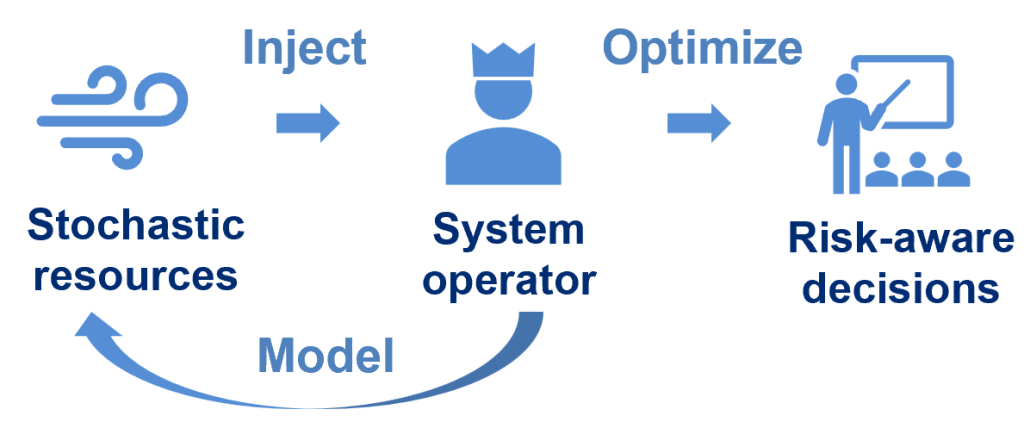
The stochastic nature and limited controllability of renewable energy reduce power system reliability. A key focus of my research addresses this issue through stochastic modeling and optimization. I developed a chance-constrained unit commitment model to price virtual inertia provision from wind turbines, solar panels, and energy storage, establishing equilibrium prices for energy, reserves, and inertia under uncertainty [paper]. Additionally, I proposed a weather-driven flexibility reserve procurement method to better quantify reserve needs driven by the unpredictability of offshore wind power [paper]. This research prepares power systems and markets for the variability and uncertainty associated with the transition to 100% renewable energy sources.
Highlight 2: Inverse Optimization for Information Recovery
Research Question: How can external entities recover hidden information in others’ decision models using observed optimal decisions?
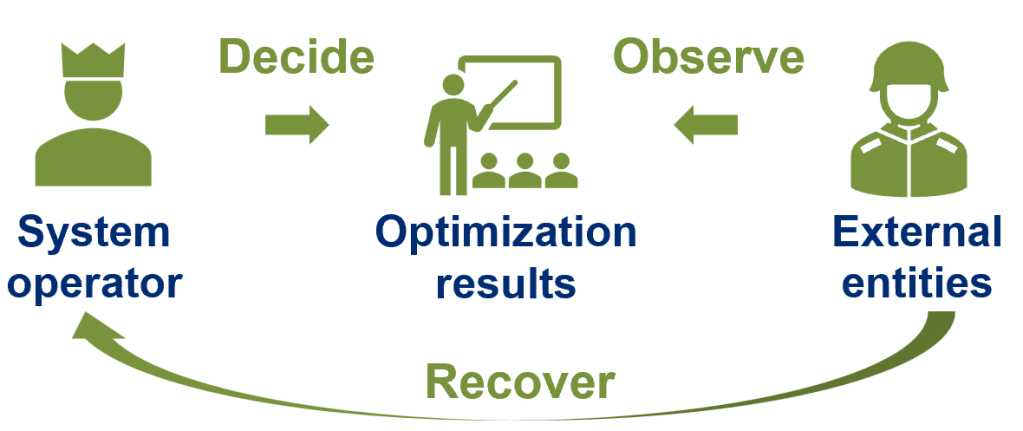
Information asymmetry in power systems and markets hampers operational efficiency. Another focus of my research addresses this challenge through inverse optimization, which reveals hidden information in power system decision models. I developed a data-driven inverse optimization model to recover generators’ marginal offer prices in wholesale energy markets, enhancing the competitive positioning of market participants [paper]. I then extended this approach by integrating stochastic modeling, proposing inverse distributionally robust optimization to infer a decision-maker’s conservativeness based on the size of a Wasserstein metric-based ambiguity set [paper]. This research overcomes the limitations of black-box machine learning and data mining by offering greater explainability and robust theoretical guarantees.
Highlight 3: Integration of Machine Learning with Optimization
Research Question: How can we efficiently integrate machine learning into optimization-based decision-making pipeline?

The unstable performance of machine learning limits its applications in power systems. The third highlight of my research explores integrating machine learning with optimization while preserving operators’ existing decision-making processes. I introduced an operation-adversarial conditional generative adversarial network to generate statistically credible extreme scenarios for power system operations by incorporating the optimal power flow gradient into training [paper]. To manage grid-edge flexibility, I developed a model-based online learning algorithm for distribution system operators to adaptively adjust incentive designs based on customer responses and historical performance [paper]. This research can help system operators build confidence in learning-based tools and unlock the potential of trustworthy artificial intelligent.
 Zhirui Liang